When your truck goes down outside of Kansas City, and you start calling around for repairs, the next ninety minutes look very different depending on who picks up the phone.
If you try to find a shop to get towed to, your truck could stay off the road for a week for a repair that takes four hours, for reasons that have nothing to do with the repair itself. That's assuming you can even get a hold of one.
If you call for a mobile repair, one of two things will happen. Either someone dispatches a tech to your driver, or they start calling around to find one.
Each minute your truck is sitting idle, the asset is not earning, and the load clock is running. The number of steps between that call and a working truck is what separates the two.
Key Findings: The fewer steps to a tech, the faster your truck gets moving
- Three-step direct dispatch: you call, they call their own tech, the tech goes out
- Dispatching its own techs means no call-around step
- A shop's wait is a queue problem, not a labor problem
- The same operation that dispatches the tech stands behind the repair
- Per-hour rate can read higher; flat structure, no fuel surcharge or port-to-port billing
What's the Step-by-Step Process When You Call a Mobile Repair Service?
Calling a mobile truck repair service like Truckup comes down to three steps: the call and intake, direct dispatch, and on-site repair.
"You call us. We call the mechanic. They go out [to you]," says David, a Truckup dispatcher. "It's a three-step process. Instead of you calling us, we call around looking, we call here, call here, call here. It's an expedited thing."
When you call a mobile truck repair service like Truckup, three things happen.
Step #1: The Call and Intake
When you call the Truckup customer service number, a dispatcher, usually either David or George, will answer the phone. They are genuinely available 24/7. David is at his phone to answer calls all day, every day.
They ask you intake questions to better understand your situation:
- The issue: What the damage was
- Company: Whether you're working with a larger fleet or an independent operator
- Contact information: So they can update you as the driver gets closer to your location
- Truck details: Unit number, make, model, year, color
The more details you can give them, the easier it is for them to help you, and the faster they can get you a tech.
George makes the same point to callers: have this information ready and dispatch can get a tech moving faster.
Step #2: Direct Dispatch
Once you give your info, Truckup then calls one of its own techs in your city and assigns them the job.
What makes mobile repair services like Truckup unique is that they deal directly with the techs themselves after a stringent vetting process, the top 1% of techs in the country. Most services use a third-party broker to call around and find whoever is available at that moment.
Step #3: On-site Repair and Release
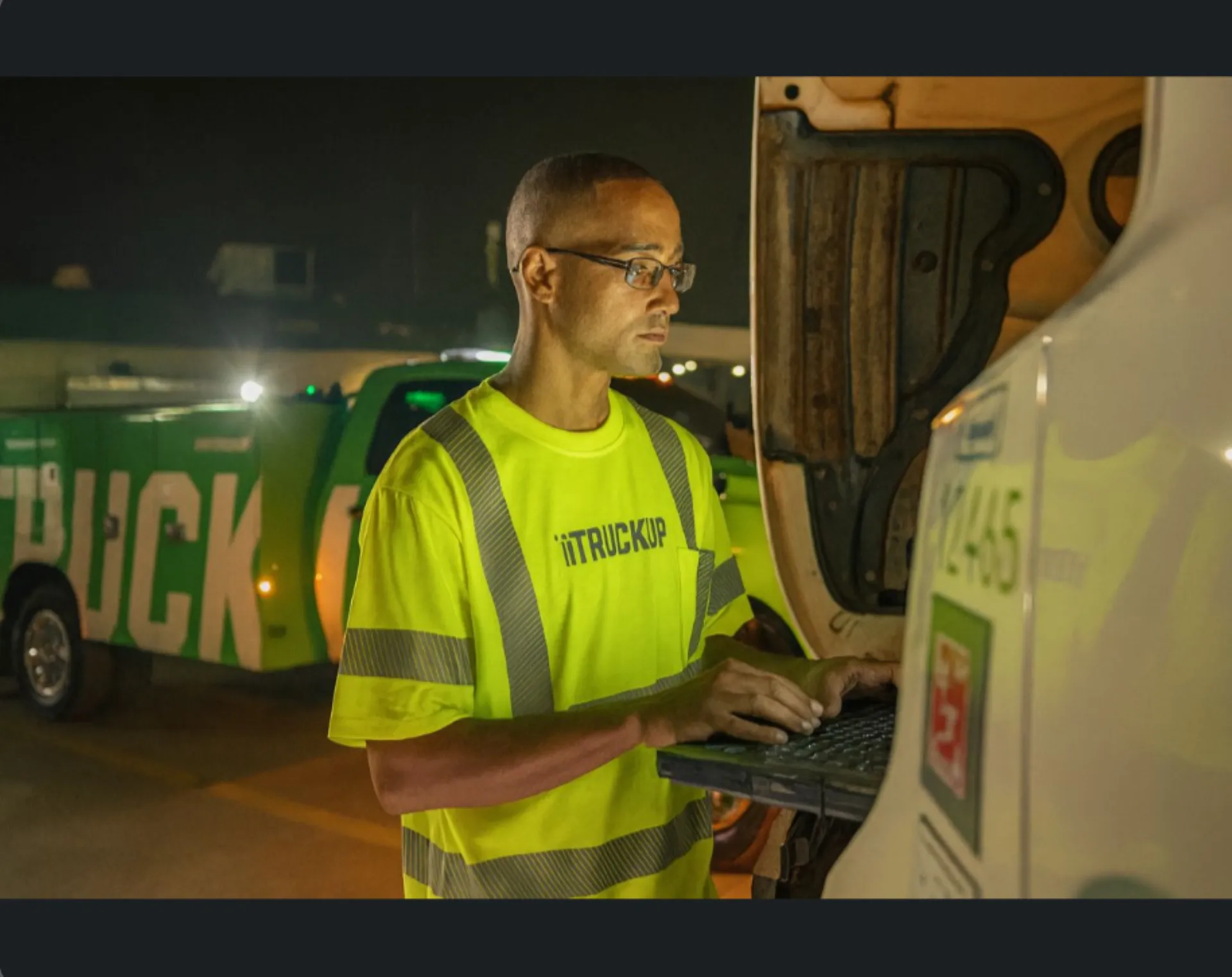
When the tech arrives, they diagnose the problem, make repairs, and get your vehicle up and running, usually within 60 to 90 minutes.
Customers without an account with Truckup pay on-site before the tech is released. Established carriers have an ongoing agreement with payment terms.
Why Does a Shop Hold a Truck for 7-10 Days When the Repair Takes 4 Hours?
An on-site repair usually takes no more than a few hours. A shop repair can easily take a week or more.
"Taking it to a shop, it's sitting there probably three days before they actually get it into the shop," says Kea Wanamaker, a fleet manager with WillScot Mobile Mini Holdings. "Your turnaround time can be anywhere from seven to 10 days."
This isn't because shop owners are bad actors. It's the way the repair shop business model is structured and incentivized.
Shops run repair jobs on bay scheduling. A mobile tech works the job in front of them. A truck at a shop waits in line until the shop has space and a tech can get to it.
There's a business incentive for shops as well. When a shop dispatches a mobile tech, it usually ends with a tow back to the shop so it funnels work back to the bay. A 100% mobile operation has to solve it on-site while the driver is stranded on the road.
"Most in-house shops, even if they have a mobile guy, most of the time they try to refer everything back to the shop," says Rey, a Truckup mobile mechanic in Arlington, Texas. "Being 100% mobile, we kind of don't have a choice but to get you going out there."
Add diagnostic backlog, parts ordering, and tech availability on top of that, and the repair process can be drawn out for weeks.
A week-long shop wait for a repair job that takes four hours to fix is a work queue problem, not a labor problem. The issue isn't tech capability; it's logistics.
Direct Dispatch vs. a Broker Calling Around
The repair is never the hard part; showing up is. The industry's core problem is no-shows and misleading ETAs.
Most roadside services route calls through third-party brokers. The broker takes the call from the fleet, then calls one tech, then another, until someone available picks up before anyone is en route.
Major tech brokers like FleetNet and TTN place the job with whoever picks up the phone. The advantage of mobile truck repair is they can send a tech that they already work with.
Reliability and consistent service are the payoff.
What Happens If the Repair Isn't Right?
24/7 mobile repair services have another advantage: if something else happens after the tech leaves, they can be sent right back to fix the problem.
Truckup warrants its own labor and the parts it supplies; if the work was at fault, the return fix is on them.
Accountability is the main differentiator in the mobile dispatch model. A broker sending a random tech to do the same job structurally cannot stand behind the work in the same way, through no fault of their own.

.avif)

