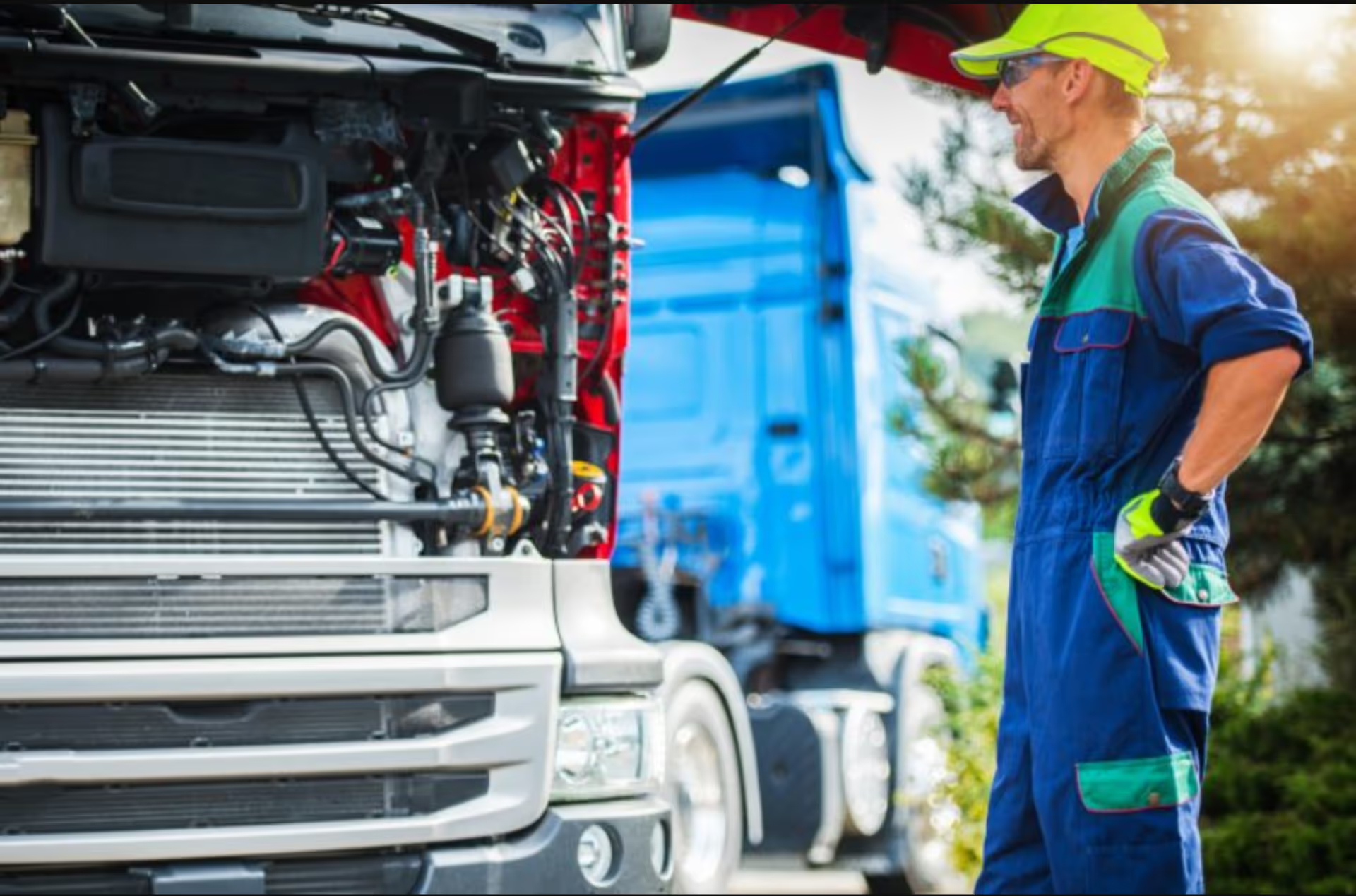
Marcus Hill, a fleet manager overseeing linehaul operations across the Midwest, noticed the alert come through on his screen while one of his trucks was deep into a delivery run along I-80. The system flagged a rising engine temperature warning, likely tied to a coolant issue that could escalate into a roadside breakdown if it wasn’t addressed quickly.
From a truck’s real-time diagnostics standpoint, everything worked exactly as intended. The fault was detected early, the issue was identified within seconds, and the driver had already pulled over to prevent further damage. Modern fleet visibility systems are built for exactly this moment: detect issues early, reduce uncertainty, and help fleets act before mechanical problems escalate.
But the truck was still sitting on the shoulder.
And that’s where a more important operational reality begins to surface. For many fleets today, downtime is no longer driven by slow problem detection. It is driven by what happens after the problem is known, specifically, how quickly a qualified truck repair technician can be dispatched, arrive on-site, and restore the vehicle to service.
Real-time diagnostics have significantly improved visibility across fleet operations, but visibility alone does not restore uptime. Once a fault is identified, the repair process still depends on technician availability, dispatch coordination, geographic proximity, equipment readiness, and field execution speed. These operational layers often introduce more delay than the actual breakdown itself.
This article explores why technician availability has quietly become one of the biggest hidden bottlenecks in modern fleet uptime, and why faster diagnostics no longer guarantee faster repairs. It breaks down where delays actually occur after a fault is detected, and why the real challenge in fleet maintenance is no longer awareness, but rapid repair execution.
The Assumption That’s Costing Your Fleet More Time Than You Realize
For many fleet operators, there’s an assumption built into how downtime is expected to work: once a problem is detected, the hardest part is already done.
A fault code appears, the issue is diagnosed, and the repair process is expected to move quickly from there. After all, modern telematics systems provide near-instant visibility into vehicle health, fault conditions, and performance data. In theory, faster information should lead to faster repairs.
But real-world breakdown response rarely works that smoothly.
Because the time between “knowing what’s wrong” and “getting the truck repaired” is often shaped by factors that exist outside the diagnostic system entirely. Technician location, dispatch coordination, repair readiness, service coverage, and travel time all influence how quickly a truck can return to operation.
And this is where the real bottleneck begins to emerge.
Fleet visibility has evolved rapidly, but the operational systems that execute repairs have not kept pace. Many fleets still rely on centralized service models, manual coordination processes, and availability-based dispatch systems designed for scheduled maintenance rather than for real-time roadside response.
As a result, downtime persists even when the issue is identified immediately. The problem is no longer detection speed. It is execution speed.
Why “Knowing Faster” Doesn’t Mean “Fixing Your Trucks Faster”
Modern diagnostic systems are extremely effective at identifying issues early. Fault codes, sensor alerts, and real-time monitoring reduce uncertainty and help fleets act before failures escalate.
But knowing what is wrong is only the first step.
What happens next is dispatching help, finding an available technician, coordinating arrival, and executing the repair, all of which are still largely dependent on manual systems and fragmented workflows. This is where time begins to accumulate, even when the problem is already understood.
The Hidden Delay Between Detection and Action
Once a fault is confirmed, the response process typically moves through several stages. You need to identify a technician to fix the issue, check their availability, confirm their location, and coordinate dispatch. Each step may seem small on its own, but together they create a delay that diagnostics alone cannot eliminate.
In many cases, the nearest available technician is not the fastest option. Or the fastest technician is not equipped for the specific issue. This mismatch introduces friction that real-time alerts simply cannot resolve.
As a result, the gap between detection and repair becomes the real source of downtime and not the breakdown itself.
Why This Assumption No Longer Holds in Modern Fleet Operations
Fleet systems have evolved rapidly in terms of visibility. Managers can now see issues as they develop, often before drivers even notice them. But the operational layer behind that visibility has not evolved at the same pace.
For most fleet managers, repair execution still depends on static workshop models, manual coordination, and availability-based dispatching. These systems were designed for planned maintenance, not for real-time response.
And that mismatch is why downtime persists, even in fleets with advanced diagnostics in place.
Technician Availability Isn’t the Same as Technician Access, And That’s Where Delays Begin
By the time Marcus confirmed the issue required immediate attention, the next step should have been straightforward: dispatch a heavy-duty mechanic to the truck and complete the repair.
But in real fleet operations, this is often where the process begins to slow down.
Most fleets already have access to diesel technicians through vendors, service partners, or internal maintenance teams, so on the surface, technician availability doesn’t appear to be the problem. Yet when breakdowns happen in real time, that availability rarely translates into immediate, on-the-ground access.
The distinction between availability and access is where many fleets lose valuable time.
A truck repair technician may technically be available within the network, but that status says very little about whether they can actually respond quickly. It doesn’t account for location, current workload, travel distance, equipment readiness, or whether the technician is equipped to handle the specific repair.
In practice, technician availability is a static measure, while breakdown response is dynamic and time-sensitive.
The difference between availability and access shows up operationally in four major areas.
Your Truck Repair Mechanic’s Availability Doesn’t Mean Proximity
A truck repair technician may be available within the network, but not within a practical distance of the breakdown. In many cases, the nearest diesel technician is already several miles away, operating in a different service zone, or finishing another job in the opposite direction. Even when a mechanic is technically “free,” travel time becomes a major factor, especially for fleets operating across wide geographic areas.
This lack of proximity creates an immediate delay before any repair work even begins. While dispatch systems may indicate that support is available, in reality, the truck remains idle until a roadside mechanic arrives on-site. For fleet managers focused on reducing downtime, proximity is just as important as availability, yet it is often overlooked in traditional service models.
Even Nearby Technicians May Not Be Equipped to Respond Immediately
Even when a heavy-duty mechanic is relatively close to the breakdown location, readiness can still be a limiting factor. The mechanic may be in the middle of another job, scheduled for upcoming work, or lacking the specific tools, parts, or diagnostic equipment required to address the issue. This introduces additional layers of coordination, extending repair timelines.
In some situations, the initially assigned diesel technician may not be fully equipped to resolve the problem, leading to follow-up visits, parts delays, or secondary dispatches. Each of these adds incremental downtime that could have been avoided with better alignment between technician capability and the specific repair need.
The Availability of a Repair Technician Doesn’t Mean Immediate Dispatch
Another critical gap lies in how technicians are assigned to breakdowns. In many fleet operations, there is no real-time system that dynamically matches a breakdown with the closest, fully equipped, and available mobile mechanic. Instead, dispatch relies heavily on manual coordination processes, including contacting vendors, checking schedules, confirming availability, and waiting for responses.
These coordination steps introduce friction precisely when speed is most important. Even small delays, waiting for a callback, verifying details, or confirming logistics, can quickly add up. As a result, valuable time is lost not because the repair itself is complex, but because the process of getting a qualified technician on-site is inefficient.
Why This Gap Has Become the Real Bottleneck
This is why technician availability across truck repair technicians, diesel mechanics, and mobile service providers has become one of the most significant constraints on fleet uptime. It is not a question of whether technicians exist within the network, but whether fleets can access the right person, at the right time, and in the right location without delay.
As real-time diagnostics continue to improve, this gap becomes even more visible. When issues are identified in seconds, but repairs still take hours to begin, the bottleneck is no longer mechanical; it’s operational. For fleets aiming to reduce downtime and improve efficiency, solving this access problem is essential to keeping trucks moving.
Why Traditional Truck Repair Service Models Break Under Time Pressure
The challenge with technician access doesn’t exist in isolation. It is deeply tied to how most fleet service models are structured. Traditional repair systems were not designed for real-time breakdown response. They were built around planned maintenance, scheduled servicing, and centralized workflows where time pressure is predictable and manageable.
That model works well when trucks can be routed into a shop, queued for service, and repaired within a controlled environment. But roadside breakdowns don’t follow schedules. They happen in transit, often far from service hubs, and require immediate action. When those real-world conditions collide with systems designed for predictability, delays become inevitable.
At the core of the issue is a mismatch between how fleets operate today and how repair networks are still structured.
Fixed Locations Limit Response Speed
Traditional repair models are centered around physical shop locations. While these facilities are essential for complex repairs, they create a structural limitation when speed is critical. If a truck breaks down far from a service center, the only options are to wait for a mobile technician to travel from that location or to tow the vehicle to the shop, both of which introduce significant downtime.
This location dependency makes it difficult to respond quickly, especially for fleets operating across long-haul routes or dispersed regions. The farther the truck is from the service hub, the longer it takes to initiate repairs, regardless of how quickly the issue was diagnosed.
Scheduling Systems Aren’t Built for Urgency
Most repair operations rely on scheduling systems designed to manage planned workloads, not real-time disruptions. Jobs are queued based on availability, technician workload, and existing commitments, which means urgent breakdowns must compete with pre-scheduled work.
Even when a diesel technician is technically available, their time is often already allocated. Adjusting schedules to accommodate unexpected breakdowns introduces delays because it requires rescheduling jobs, confirming availability, and coordinating changes across multiple parties.
This creates a lag between identifying the problem and actually beginning the repair, one that diagnostics alone cannot eliminate.
Dispatch Relies on Manual Coordination
In many fleet operations, dispatching a truck repair technician is still a largely manual process. Fleet managers or dispatch teams must contact vendors, verify availability, confirm location, and coordinate logistics before a mechanic can even be assigned.
This back-and-forth communication adds friction at every step. Each call, confirmation, and delay compounds the overall response time, especially when multiple service providers are involved. Without real-time visibility into technician location and readiness, fleets are left to coordinate responses reactively rather than execute them instantly.
Coverage Gaps Slow Down Response Times
Traditional service networks are not evenly distributed across all operating regions. While urban areas may have strong coverage, breakdowns in remote or less-serviced corridors often result in longer wait times due to limited access to nearby diesel technicians or mobile mechanics.
These coverage gaps create inconsistent response times, making it difficult for fleets to maintain predictable uptime across their operations. A truck in one region may receive rapid support, while another in a different location waits significantly longer for the same issue.
Why These Limitations Lead to Downtime
Individually, each of these constraints, like fixed locations, scheduling delays, manual dispatch, and uneven coverage, adds friction to the repair process. Together, they create a system that struggles to respond at the speed modern fleet operations demand.
This is why even fleets with advanced diagnostics still experience significant downtime. The issue is no longer about identifying problems quickly; it’s about executing repairs without delay. And when the underlying service model cannot support real-time response, technician availability alone is not enough to keep trucks moving.
The Fleets Reducing Downtime Fastest Are Rebuilding How Repairs Are Dispatched
For fleets focused on reducing downtime, the solution is no longer just improving visibility into vehicle health. The bigger shift is happening in how repairs are coordinated, deployed, and executed once a problem is identified.
Instead of relying entirely on centralized shop networks and static service scheduling, many fleets are moving toward more distributed repair models designed around speed, geographic coverage, and real-time response.
The goal is simple: reduce the time between fault detection and repair execution.
This operational shift is changing how fleets think about maintenance infrastructure altogether. Rather than treating repair as a fixed-location service function, modern fleet operations increasingly treat repair response as a mobile, dynamically coordinated system that supports trucks wherever they operate.
As uptime pressures increase, the fleets recovering fastest from breakdowns are often the ones redesigning how technicians are deployed in the field.
- Distributed Technician Networks Reduce Geographic Delays
One of the biggest changes happening in modern fleet maintenance is the shift away from relying solely on centralized repair hubs. Instead of depending on a limited number of fixed shop locations, many fleets are building access to distributed, decentralized technician networks that position heavy-duty mechanics across wider operating regions.
This approach addresses one of the largest hidden causes of repair delays: geography.
In traditional service models, the time required to reach a disabled truck often depends on how far the vehicle is from the nearest repair facility. Even when the issue is diagnosed immediately, valuable time is still lost waiting for a technician to travel long distances or arranging to move the truck to a shop. For long-haul fleets operating across multiple states or remote freight corridors, those delays can quickly compound.
Distributed repair coverage changes that dynamic by reducing the physical distance between breakdown events and available service support.
Instead of routing every repair request through a centralized location, fleets can access technicians positioned closer to active operating routes. This allows roadside response to begin faster and reduces the amount of idle truck time created before repairs even start.
The impact goes beyond response speed alone. Broader technician coverage also creates greater operational flexibility during high-demand periods, severe weather events, regional breakdown surges, or unexpected service disruptions. When support is spread across multiple areas rather than concentrated in a handful of locations, fleets are better positioned to maintain consistent repair response across their networks.
As freight operations become more time-sensitive, distributed technician infrastructure is increasingly becoming a core part of how fleets improve uptime reliability at scale.
- Mobile Truck Repair is Turning Repair Time Into Response Time
Traditional maintenance systems were built around a simple assumption: when a truck breaks down, the truck goes to the repair shop. But that model creates delays long before repair work actually begins.
Towing coordination, shop intake queues, scheduling backlogs, and transportation logistics all add time between the moment a fault is detected and the moment a technician can begin working on the issue. In many roadside breakdown situations, the repair itself may take less time than getting the truck into a service bay.
That is one reason mobile truck repair has become increasingly important in modern fleet operations.
Rather than centering the repair process around fixed locations, mobile repair mechanics bring equipped heavy-duty mechanics directly to the truck. Service vans stocked with diagnostic tools, repair equipment, and commonly needed parts allow many issues to be addressed on-site without requiring the vehicle to leave its route entirely.
This fundamentally changes the repair timeline.
Instead of spending hours coordinating transportation and shop access, fleets can begin the recovery process immediately where the breakdown occurs. In many situations, this compresses multiple delay stages into a single dispatch process, significantly reducing roadside recovery time.
Mobile repair infrastructure also improves operational continuity during time-sensitive freight movement. Trucks carrying critical deliveries, temperature-sensitive freight, or tightly scheduled loads can often return to service more quickly when repairs are performed closer to the point of failure.
As fleets continue prioritizing faster response windows and reduced idle time, mobile truck repair is increasingly shifting maintenance strategy away from centralized recovery models toward field-based execution.
- Real-Time Technician Visibility Improves Dispatch Speed
One of the biggest limitations in traditional breakdown response is the lack of real-time visibility into technician status once a repair request is initiated.
In many fleet operations, dispatch decisions still rely heavily on manual communication. Coordinators contact service providers, check technician availability, confirm locations, verify capabilities, and attempt to estimate response times before assigning the job. Even when each individual step only takes a few minutes, the combined delay can significantly extend repair response windows.
Modern dispatch-oriented repair networks are beginning to reduce that friction by improving visibility into where technicians are, what equipment they carry, and whether they can handle a specific issue immediately.
This operational visibility enables fleets to make faster assignment decisions, not only based on availability but also on proximity, readiness, workload, and repair capability.
That distinction matters because the closest technician is not always the fastest solution. A nearby mechanic without the necessary diagnostic equipment or replacement parts may still require additional dispatch coordination later, further extending the repair process. More effective dispatch systems reduce this mismatch by aligning repair needs with technician capability from the beginning.
The result is a more compressed response cycle between fault detection, technician assignment, arrival, and repair execution.
As repair coordination becomes more time-sensitive, real-time visibility into technicians is becoming increasingly important, just as vehicle visibility is.
- High-Performing Fleets Are Eliminating Coordination Delays
For many fleets, some of the longest delays during a breakdown do not come from the repair itself. They come from the layers of coordination required before repairs can even begin.
Calls between dispatch teams and service providers, approval processes, schedule confirmations, technician reassignment, parts verification, and repeated status updates all create friction within the repair workflow. These steps may seem minor. Operationally, they can extend service response times by hours.
High-performing fleets are increasingly focusing on reducing these coordination gaps.
Instead of treating breakdown response as a sequence of disconnected handoffs, they are streamlining how information moves between diagnostics systems, dispatch teams, technicians, and service networks. The goal is to shorten the operational distance between identifying a fault and beginning the repair.
This often means simplifying dispatch workflows, improving communication between field technicians and coordinators, and reducing the number of approval layers required to initiate roadside service. In some operations, repair planning begins immediately after fault confirmation rather than after multiple rounds of manual coordination.
The operational advantage of this approach is speed.
When fewer administrative and communication barriers exist between detection and execution, fleets can reduce repair lag, improve roadside recovery times, and return trucks to service faster.
As fleet utilization demands continue to increase, the ability to compress coordination time is becoming a major competitive advantage for maintaining uptime consistency across large operations.
- Why Faster Repair Execution is Becoming a Competitive Requirement
Fleet operations today run under far tighter performance expectations than they did even a few years ago. Delivery windows are narrower, asset utilization targets are higher, and operational disruptions carry greater financial consequences across the supply chain.
Under these conditions, delays that once seemed manageable now create significant downstream impact.
A truck sitting idle for several hours no longer affects just a single load. It can disrupt delivery schedules, reduce driver productivity, affect customer commitments, create rescheduling pressure across dispatch operations, and limit overall fleet capacity. As freight movement becomes more time-sensitive, the operational cost of slow repair response continues to rise.
At the same time, many fleets are operating with less margin for disruption. Higher equipment utilization means trucks spend more time on the road and less time sitting unused within terminals or yards. That leaves less flexibility to absorb unexpected breakdown delays.
This is one reason repair execution speed is becoming increasingly important within fleet operations.
For years, maintenance strategy has focused heavily on improving diagnostics visibility and preventive maintenance planning. Those capabilities remain essential, but they no longer solve the entire uptime equation on their own. Once a breakdown occurs in real-world operating conditions, the fleet’s ability to coordinate and execute repairs quickly becomes just as important as identifying the issue itself.
As a result, many fleets are beginning to view maintenance infrastructure differently. The conversation is shifting away from simply “who can repair the truck” toward “who can restore the truck to operation fastest.”
That shift is reshaping how fleets evaluate repair networks, technician coverage, mobile service capability, dispatch systems, and roadside response coordination. Increasingly, uptime performance is influenced not just by maintenance quality but also by how efficiently repair operations move from detection to execution under real operating conditions.
And as delivery expectations continue to rise across the industry, fleets that reduce execution delays will likely gain an increasing operational advantage over those still relying on slower, centralized response models.
As fleet operations become more time-sensitive, the ability to reduce delays between fault detection, technician dispatch, and repair execution is becoming a major differentiator in overall uptime performance.
For many fleets, the challenge is no longer simply identifying mechanical issues quickly. It is building repair response systems capable of acting on that information fast enough to keep trucks moving.
Conclusion
When Marcus Hill’s truck flagged a rising engine temperature, the fleet’s diagnostic systems did exactly what they were designed to do. The issue was detected early, the driver responded correctly, and the risk of engine damage was reduced before it escalated.
But the truck still spent time sitting still. Because once the problem was identified, the real challenge wasn’t visibility. It was execution.
Getting the right truck repair technician to the truck, at the right time, with the right tools, became the factor that determined how quickly the vehicle returned to service. And in that gap between detection and repair, most fleet downtime quietly accumulates.
This is the shift many fleet operators are now confronting. Real-time diagnostics have significantly improved awareness of mechanical issues, but they have not removed the operational delays involved in resolving them. Technician access, dispatch coordination, geographic coverage, and repair readiness now play an equally critical role in determining uptime outcomes.
As fleet operations become more time-sensitive and asset utilization continues to increase, the ability to move from fault detection to repair execution quickly is becoming a defining factor in overall performance.
In modern fleet management, knowing what is wrong is only valuable if it leads to it being fixed fast enough to keep trucks moving.