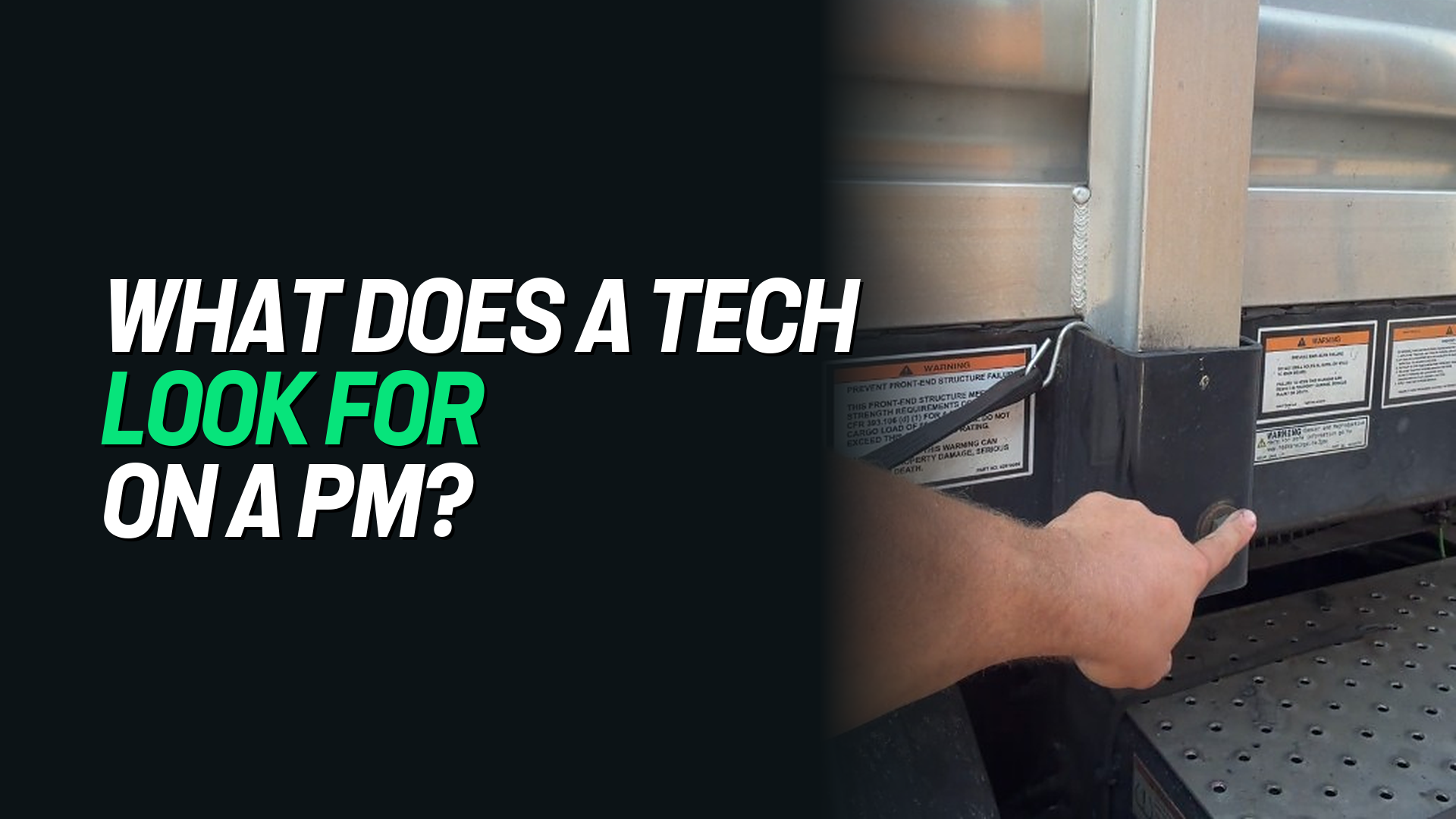
Ben arrived at a customer's yard in central Indiana in the early evening with a road call already behind him and five trailer preventive maintenance inspections on the list. He had one hour allotted per trailer and a checklist that runs two to three pages.
He recorded the first one on camera.
What follows is that inspection in the order he worked it, plus the sheet he worked from. It is a flatbed trailer at a steel-hauling fleet, so some line items are specific to flatbeds. The structure is not. Any fleet buying preventive maintenance is buying some version of this hour, and the useful question for the person paying for it is what that hour actually covers and what comes back at the end of it.
Key Findings
A PM inspection is not a repair. It is the process that produces the repair list.
- The fleet allots one hour per trailer against a two-to-three-page sheet. Ben's assessment: "it takes every bit of that."
- Certain measurements get written down rather than judged: brake lining, brake stroke and tire tread depth are recorded on the sheet every time.
- This trailer produced two findings in the first pass, and neither would have stopped it that day. The rub rail was missing its DOT tape, and a wheel had a damaged rim on a tire that was still holding air.
- Findings do not become repairs automatically. Both items went on the report for the customer to approve.
- Brake-related problems accounted for 41.1% of vehicle out-of-service violations in the 2025 International Roadcheck (CVSA). Brakes are the longest section of the sheet.
What is on a trailer PM sheet
Ben read the fleet's sheet aloud on camera. Page one runs roughly in this order:
First, the body inspection
- All exterior lights
- Gladhands and the seven-way plug
- ID plates, registration holder, and the condition of decals including safety and operations
- ICC bumper, mud flaps, mounting brackets, fenders, light boxes, floor, threshold plate
- License plate and permits
Next, the structure is inspected:
- Upper coupler (checked for cracks, wear and bolts)
- Kingpin
- Dolly legs, braces and brackets
- Frame and subframe (checked for cracks and bolts)
- Cross members and gussets
- Spring hangers, wear pads, air suspension, equalizers, bushings, radius rods
- Alignment
- Springs, U-bolts, saddles and seats
- Grease the trailer
Finally, the brake system is checked:
- Brake lining (recorded)
- Drums, rotors, chambers, hubs
- Brake adjustment
- Slack adjusters and brake valves
- Brake tubing and air tanks
- Wheels and tread depth
Four things get written down as measurements rather than pass-or-fail judgments: tire tread depth, brake lining, brake stroke, and tread depth again on the wheel section.
Page two covers the flatbed itself: side rails, flooring, bulkhead, tarps, tie-downs, ratchets.
"It's a pretty thorough inspection," Ben said.
The walkthrough, front to back
The truck maintenance starts at the front, with the trailer still connected to the tractor so the lights can be run.
At the bulkhead: damage, welds not broken, bolts still securing it, rivets in place. Then the rub rail, which is the part he flags as taking more damage than people expect. "Lots of times these welds get damaged, making sure those are all good."
Moving down the frame: cross members for secure bolts and for cracks, dolly legs for their mounting bolts, cross braces, gussets, everything checked for whether it is still secured.
Underneath is where most of the work is. Brakes, chambers, shocks. Airlines checked specifically for rubbing. Slack adjusters and S-cams. Then up into the subframe: cross members, more airlines, and the airbags. Inner wheel seals and ABS. Lugs.
Around the wheels: tread depth and PSI on every tire. This trailer runs a tire self-inflation system, which keeps pressure up and can mask a problem underneath it.
Then hangers, mud flap brackets and mud flaps, the ICC bumper and the rear lights. This trailer was backed into the grass, so Ben noted he would pull it forward before checking the bumper and lights rather than skip them.
Up on the deck: flooring bolts, the flooring itself checked for major holes, and the sliding winches, which have to actually slide for a driver to secure a load with them. The side box for extra straps and tarps.
Then the same pass down the other side.
What this one turned up
Two findings on the first walk, and a third on the neighboring unit.
The first was at the rub rail. The trailer was missing its DOT tape, the reflective conspicuity marking required along the side. Ben showed both trailers on camera to make the comparison plain: "as you can see, this trailer, the rub rail is missing the DOT tape. If you look right here, this one has DOT tape on the rub rail." The far side was missing it too.
The second was a wheel. "The tires still aired up," Ben said, "but the rim's damaged." It went on the sheet.
The third was on a trailer he was not there to inspect. He noticed it needed tape on its ICC bumper and flagged it anyway.
None of the three would have stopped a truck that evening. A tire holding air looks like a tire that is fine. Missing reflective tape is invisible from the driver's seat. Both are the kind of finding that costs nothing to catch in a yard and something to discover somewhere else. Richard, who covers Indiana for the same company, described the somewhere else: a truck that had just been through a DOT inspection at a quick-service facility was shut down at a weigh station because it had no DOT stickers or paperwork in the cab.
Neither finding became a repair on the spot. Both went on the report for the customer's contact to approve. That is the standard arrangement on a fleet PM account, and it is also the point at which the value of the inspection is decided by the fleet rather than the technician.
Why no PM comes back clean
Ben's expectation going in is that the sheet will produce work.
"Most of the time you're not gonna have a perfect PM," he said. "You're gonna find it's got a light out, needs fixed. It's got a brake, needs fixed, a wheel seal. So lots of times there's follow up work."
That is the design rather than a failure of it. An inspection that returns nothing on a working trailer either caught a genuinely clean unit or did not look hard enough, and over a fleet and a year the second is more likely than the first. The measurements recorded on the sheet exist for the same reason: a lining thickness written down twice, three months apart, is a wear rate, while a lining marked "OK" twice is two opinions.
Ben works past the boundaries of the job for the same reason. About every other trailer at the yard had a tractor hooked to it, and since the lights were already on for the trailer, he checked the tractor's lights as well. Tires kicked. Mirrors. Anything obvious. He was not there to inspect the trucks.
"It's just a quick glance, and you never know," he said, "you might find something."
Richard's version of the same instinct is on the parts side. He replaces air cleaners, fuel filters and water fuel separators earlier than he has to, on the reasoning that he would rather change one early than have it down a truck later.
What the hour buys
For a fleet, three things are worth taking from this.
An hour per trailer is a real number, not a rounding of one. It covers a full sheet including the measurements, and Ben's read is that it takes all of it. A vendor quoting materially less is either working a shorter sheet or not recording what this sheet records, and both are answerable questions before a contract starts.
The inspection produces a list, not an outcome. What the trailer got that evening was a report with DOT tape and a damaged rim on it. Whether either becomes a repair depends on how fast the approval comes back, which is a fleet process rather than a vendor one.
Most of what a PM finds is not urgent yet. The tape and the rim were both things a truck can run on. They are also both things that turn into a violation or a road call at a time nobody picks.

.avif)

