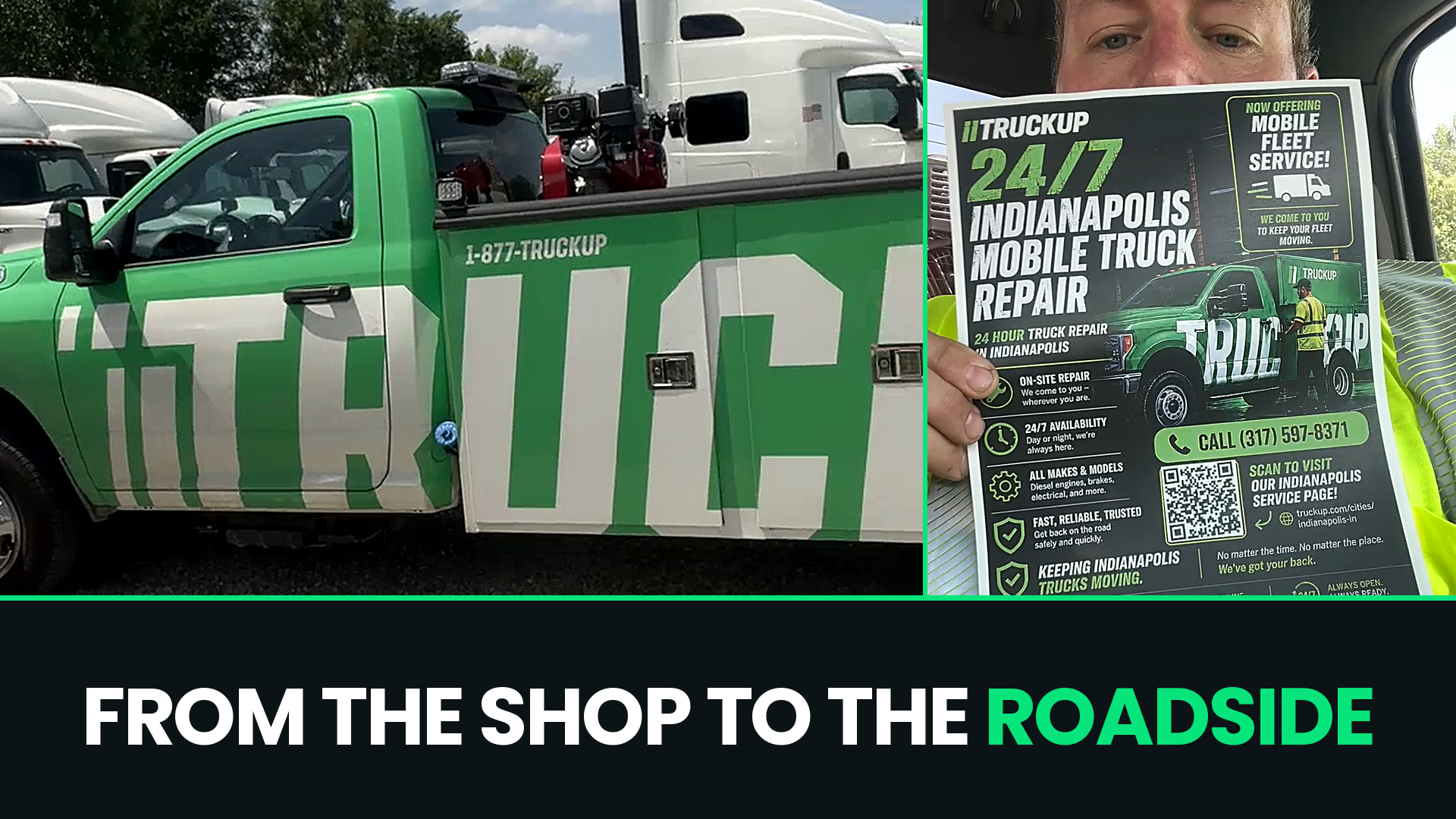
Ben spent five years managing diesel repair shops before he went back to turning wrenches.
He was not looking for work when he made the move. He saw a listing one evening and applied for it, out of boredom.
"I just randomly saw this on Indeed. I didn't know if I was actually looking to start another job," he said. "I always enjoyed turning wrenches, and now I'm back into wrenching."
That is about 15 years in the diesel field: 10 to 11 under trucks, five running the shops other mechanics worked in, then the field again by choice. He covers Indianapolis and the surrounding area on 24/7 mobile repair.
Most people comparing a shop to a mobile technician have worked one side of it. Ben has run both.
KEY SUMMARY
- A dealership divides work among specialists: clutches and transmissions, wiring, aftertreatment diagnostics, oil changes, tires. A mobile technician carries all of it, and the tools for all of it, in one truck.
- On a September road call he diagnosed a blown hydraulic line, pulled it, drove 35 minutes to have a replacement made, drove back, fitted it and tested it. One person, no bay.
- That repair took about half an hour. The waiting and driving around it took most of the day.
- The most expensive way he has watched a fleet try to save on repairs is not a part. It is a stretched oil-change interval.
WHAT A DEALERSHIP SPLITS FIVE WAYS
Ben's specialty is aftertreatment diagnostics: DEF systems, diesel particulate filters, exhaust. He has worked on all the major makes. The difference he points to between a dealership bay and the roadside is not skill. It is coverage.
"In a dealership world, they have a guy that does clutches and transmissions, then they have a guy that does wiring, then they have a guy that does aftertreatments and diagnostics on the laptop, then they have a guy that only does oil changes," he said. "Out here in the field, you gotta do all that. We gotta be able to do tires, oil changes, diagnostics, the wiring, everything. You gotta know what you're doing and have the tools to do it."
That split is not a flaw in the dealership model. It is what volume buys. A shop seeing enough trucks can afford to put one person on transmissions all day, and that person gets very good at transmissions. The tradeoff is that the truck has to come to where those people are, and wait its turn among them.
A mobile technician inverts both halves. Nobody specializes, and nothing queues. Which arrangement is better depends on what is wrong with the truck and where it is standing.
"Rain, snow, heat, whatever. I've got a poncho."
ONE LINE, TWO TOWNS, ONE TECHNICIAN
In September, Ben took a call on a car hauler at a dealership lot in Greensburg, Indiana, about an hour out. A hydraulic line had blown.
He diagnosed it, pulled the line, drove 35 minutes to Columbus to have a new one made, drove back, fitted it, put almost twelve gallons of fluid in the tank and tested for leaks. Then he drove 35 minutes the other way to a yard with five trailer inspections still on the list. No parts counter, no second technician, no service writer.
The repair itself took about half an hour. The rest is what the fleet paid for: roughly half an hour to an hour before dispatch settled on who to send, an hour for him to reach the truck, over an hour for the line, then the fit and the test.
The driver was not local.
"He's definitely losing, especially drive time, 'cause he said he had to get back to Michigan," Ben said.
In a shop, the same failure produces a tow, an intake, and a place in the queue behind whatever is already in the bays. The diagnosis may be quick. The truck still waits. The mobile version trades the tow and the queue for drive time and a parts run, and the truck never leaves the lot it stopped in.
WHERE HE SEES FLEETS LOSE MONEY
Asked for the most expensive thing he has watched a fleet do to save money on repairs, Ben does not name a part. He names an interval. Some fleets change oil every 20,000 miles, some every 30,000 or 40,000. A company he worked for before ran 50,000.
"Obviously, they're due when they're due," he said. "Most companies change it sooner than that."
WHAT HE TELLS OTHER TECHNICIANS
Having spent five years on the other side of it, Ben is a credible witness on how mechanics get managed.
"You gotta be willing to deal with the elements out here, and working on the side of the highway sometimes," he said. "But David and Caleb, the dispatchers, everybody's great to work with. They're never ever hounding me. I know lots of guys that work at shops and they get hawked on, someone's always looking over their shoulder, or they don't get the please and thank you that they're looking for. David gives me that. 'Hey, thanks for working 14 hours and getting that job done even though it was late.'"
BUILDING A BOOK AROUND INDIANAPOLIS
Call volume swings between ten dispatches a day and two. What Ben wants is the steady work underneath: fleets around Indianapolis he can maintain on a schedule, with breakdown response on top. He already shares one steel-hauling account with Richard, the other Indiana technician, taking trailer maintenance off his list.
"I would like to find a fleet, multiple fleets, anything that I can take care of," he said. "If you've got a breakdown, I'll come do it. You need tires, I'll come do it. Lights, PMs, oil changes, check engine lights. I need some people that I can take care of."
Ben covers Indianapolis and the surrounding area, 24/7. Fleet inquiries reach him at (317) 597-8371.

.avif)