
In the fast-paced world of fleet management, every mile matters, and every breakdown costs more than just money. Whether overseeing a few delivery vans or managing a fleet of semi-trucks, how you approach vehicle maintenance can significantly impact your bottom line. The real battle lies in preventive fleet maintenance vs. emergency repairs.
Relying solely on emergency repairs is a practical short-term solution. Still, it often leads to inflated repair bills, costly downtime, and delayed deliveries that frustrate your clients and damage your reputation. On the other hand, implementing a proactive and preventive maintenance strategy helps you avoid surprises, reduce operating costs, extend vehicle lifespan, and boost overall efficiency.
This article will break down the key differences between preventive and reactive maintenance, reveal the hidden costs of emergency repairs, and provide actionable tips to optimize your fleet maintenance strategy. From adopting smart technologies to training your drivers to spot early warning signs, you'll discover how to keep your fleet on the road and your expenses in check.
If you're ready to stop chasing breakdowns and start building a reliable, cost-efficient fleet, this guide is for you. Let's jump right in.
Preventive Fleet Maintenance vs. Emergency Repairs: Understanding the Difference
Preventive Maintenance
You engage in preventive maintenance when you schedule an inspection to evaluate the state of your semi-trucks' components, service them, and repair defective ones before your trucks are in operation. This proactive strategy is essential for keeping your semi-truck in optimal operating condition.
Embracing this proactive approach will require you and your truck operators to set a series of inspections and routine servicing to identify and address potential issues before they escalate into serious problems. However, this strategy often requires a significant upfront investment.
The costs will cover various services, including oil changes, brake inspections, tire rotations, and thorough inspections of key systems, such as the engine and transmission. By allocating these resources wisely, you can ensure that your trucks remain reliable and safe on the road, ultimately saving you from more extensive repairs and downtime in the future.
Preventive Maintenance Facts
- You have the opportunity to address any upcoming issues before they arise.
- This proactive measure is less costly than handling emergency fixes after a roadside breakdown.
- Schedule and attend to all truck repairs and maintenance early before a trip to minimize breakdowns during the journey and ensure no missed delivery deadlines.
- Your truck repair technician will have sufficient time to inspect and repair your vehicle as scheduled, ensuring that no downtime costs are incurred.
- All tears and wear will be addressed promptly, reducing the risk of emergency breakdowns and accidents.
- With routine maintenance and early repair, your vehicle will have a longer lifespan.
- As a fleet manager who adores preventive maintenance, you will have less stress handling frustrating emergency breakdowns, the fear of unqualified personnel fixing your vehicle, expensive repairs, and daunting phone calls from disappointed customers due to missed deadlines.
- Moreover, with early repairs and maintenance, your heavy-duty truck will operate efficiently and without issues for long periods, increasing productivity.
Emergency Truck Repair
On the other hand, emergency truck repair, also known as reactive repair, often happens after a breakdown. Your driver will report a breakdown on the roadside, which will require you to contact a nearby mobile heavy-duty mechanic or repair shop, who will work to fix the issue and keep your vehicle moving.
With emergency repair, the exact course of the breakdown is only addressed when it occurs. This can be inconvenient to your fleet and customers as you will likely incur expensive repair costs, downtime, and sometimes a fine for obstructing traffic.
Facts About Emergency Repairs
- Repair costs can be high due to the need for urgent labor and towing, especially when compared to preventive maintenance.
- Delayed or complicated repairs can lead to increased downtime, resulting in financial losses for your fleet.
- This may also lead to a poor customer experience and the potential loss of clients due to delayed deliveries.
- Additionally, if your trucks are not well-maintained and experience more breakdowns, their lifespan will be reduced.
- Additionally, most issues are resolved as they occur. This usually happens while your big rig is on the road. As a result, your fleet's production may decline. You will spend a lot of time solving problems as they arise.
How Do Costs Differ Between Preventive and Reactive Repairs?
The financial implications of maintenance strategies extend beyond immediate costs and can have a significant impact on long-term operations. Here’s a closer look at the distinctions:
Emergency Repairs
When an unexpected roadside emergency breakdown arises, costs can escalate quickly due to the urgency involved. These unplanned repairs typically incur high charges for quick services, additional labor fees for after-hours work, and immediate part replacement, all of which can strain budgets.
The hidden costs of emergency repairs: Unexpected downtime from vehicle failures can severely disrupt your business operations. Statistics show that a truck can lose an average of $448 to $760 daily during downtime. For instance, if you manage a fleet of 120 trucks and, in just one week, 10 of your trucks experience an emergency breakdown, each taking at least a day or two to repair, your fleet will likely incur an unimaginable cost.
The market Impact of reactive repairs: Delays in deliveries can harm a company's reputation, leading clients to seek alternatives among competitors, which may have long-lasting repercussions on business relationships.
Preventive Maintenance
While exercising preventive maintenance to ensure your semi-truck is in good operating condition, you will incur significant upfront costs that will help facilitate routine servicing. You can estimate the total expense you may need during routine maintenance, which will help you estimate the amount to set aside for each truck to cover maintenance services.
Although this proactive approach requires an upfront investment in routine servicing, it offers predictable maintenance and fleet repair costs that you can plan on and budget over time.
Preventive maintenance will provide you with an opportunity to;
- Save on operational costs: As a fleet manager, you can negotiate for discounts with service providers and truck accessory dealers. This will enable you to access parts and maintenance services at lower rates, reducing expenses and contributing to your organization's overall financial health.
- Address any repair issues to prevent other equipment in your truck from sustaining extensive damage, which can lead to costly repairs. A study shows that every dollar you invest in preventive maintenance can save up to $4 in repair costs, including towing and emergency services.
- Boost your fleet’s reliability: Inspect your trucks to identify issues, have them fixed promptly before a trip, and schedule routine maintenance to ensure they are reliable for deliveries. This will ensure fewer roadside issues and timely deliveries of goods to a customer’s destination. This will strengthen your client’s trust and loyalty, positively impacting your company’s reputation and paving the way for long-term success.
Considering these factors will help you make informed decisions for your organization. Schedule early maintenance plans to ensure your fleet is in good condition, balance short-term and long-term expenses, and increase customer satisfaction, thereby earning their trust.
Here’s something to chew on: If 10 of your trucks experience just 10 unexpected breakdowns a year and a single downtime costs $ 500, that could rack up $5,000 to $10,000 in repair costs, not including lost revenue from delays. Now multiply that by 10 or 100 vehicles. You could have lost a lot.
How Preventive Maintenance Saves Money
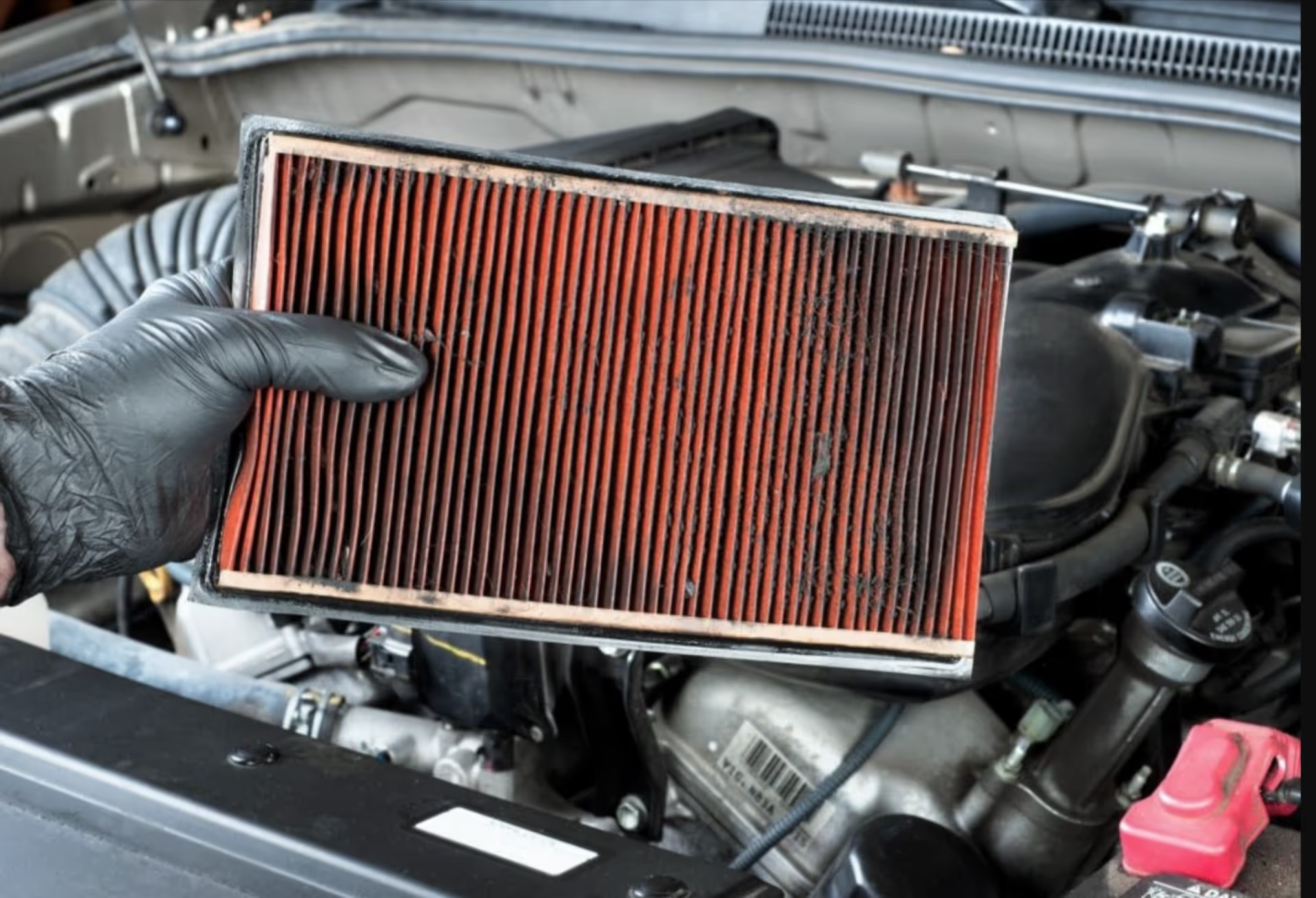
- Proactive and predictive maintenance will improve your fleet’s fuel efficiency. With a well-maintained engine, aligned tires, clean spark plugs, oil and air filters, your semi-trucks will consume fuel efficiently and reduce the issues of exhaust smoke and pungent smell due to unburnt fuel resulting from incomplete combustion, imbalance in air-fuel mixture, or leaks in the combustion chamber, faulty spark plug, or fuel injector.
- The preventive maintenance strategy will prolong the lifespan of your trucks. With early repairs, you can address a problem before it escalates, potentially leading to significant damage that may affect other truck components and result in costly repairs.
- A well-maintained semi-trailer will likely have a high resale value because it signifies quality and reliability. For several reasons, a semi-trailer that looks good and is in excellent working condition can attract more buyers. Moreover, regular upkeep demonstrates to potential buyers that the trailer has been cared for, minimizing concerns about hidden issues or necessary repairs.
- Enhancing your proactive and predictive maintenance strategies can be crucial in lowering liability risks and insurance premiums. By ensuring that your fleet is well-maintained, you can significantly decrease the likelihood of breakdowns and accidents, which helps to keep your company's insurance coverage intact. Moreover, as a fleet manager, you’ll benefit from the peace of mind that comes with avoiding emergency repair costs, allowing you to allocate your resources more efficiently.
- Your truck will not require expensive insurance coverage. Since it is always in good condition, it will incur fewer breakdown issues and accidents, resulting in minimal lawsuits, and saving your organisation expenses.
Tips to Maximize Efficiency and Minimize Repair Costs
1. Adopt a Digital Fleet Management System
The traditional method of tracking fleet maintenance using spreadsheets is outdated and prone to errors. You need fleet management software that allows you and other truck operators to access the truck’s information from a central point for easy management and operation.
Adopting a customized fleet management system will keep you updated on the vehicles due for maintenance and their status, and even flag your truck patterns before they become problems. Fleet maintenance is not just about changing oil, but about using data to predict and mitigate problems before they occur. This will help you address issues promptly before they escalate to expensive repairs.
2. Standardize Your Inspection Checklists
As a fleet manager, you must also train your drivers to conduct pre- and post-trip inspections to identify and report any truck problems and make timely repairs. Use a truck maintenance checklist as a guide to inspect all critical areas of your semi-truck and ensure they are in good working condition.
This “catch it early” approach will help prevent minor issues from becoming major expenses and save your company from emergency costs.
3. Schedule Maintenance Based on Mileage, Not Just Time
Utilize modern telematic tools to help you track and schedule maintenance according to your vehicle's usage patterns. These advanced tools can collect and analyze driving habits, engine performance, and mileage data, allowing you to tailor maintenance schedules to each vehicle's needs.
This approach will help ensure that your fleet receives the appropriate level of care, preventing both over-servicing, which can lead to unnecessary expenses and downtime, and under-maintenance, which can result in costly breakdowns and repairs.
By utilizing these data-driven insights, you can optimize the performance and longevity of your vehicles while enhancing overall fleet efficiency. This ensures you're neither over-servicing nor under-maintaining your fleet.
4. Educate Your Drivers
Your drivers stay behind the wheel and are always conversant with how different components work. You can offer them extra training to help them spot and interpret early warning signs of common issues, such as dashboard lights, tire and engine noise, fluid leaks, and system malfunctions, so they can report and have them fixed before they escalate.
With early reporting, you'll have the issues fixed on time at a lower rate, rather than waiting for a breakdown that will incur expensive towing costs, immediate mobile mechanic charges, or fines for obstructing traffic.
5. Track the Total Cost of Ownership (TCO) of Your Vehicles
You need to consider more than just the initial purchase price of a vehicle. You can gain a clearer picture of a vehicle's overall value by factoring in ongoing expenses such as maintenance, repairs, downtime, and fuel costs. This comprehensive approach can help you determine when it might be more cost-effective to replace a vehicle rather than continuing to invest in it.
A Quick Self-Assessment to Examine Your Fleet Maintenance Strategy
Before you dive deeper into overhauling your maintenance approach, let’s evaluate your current state. Here is a set of questions to help you self-check your fleet maintenance strategy and identify blind spots, inefficiencies, and opportunities for improvement.
Ask yourself these questions;
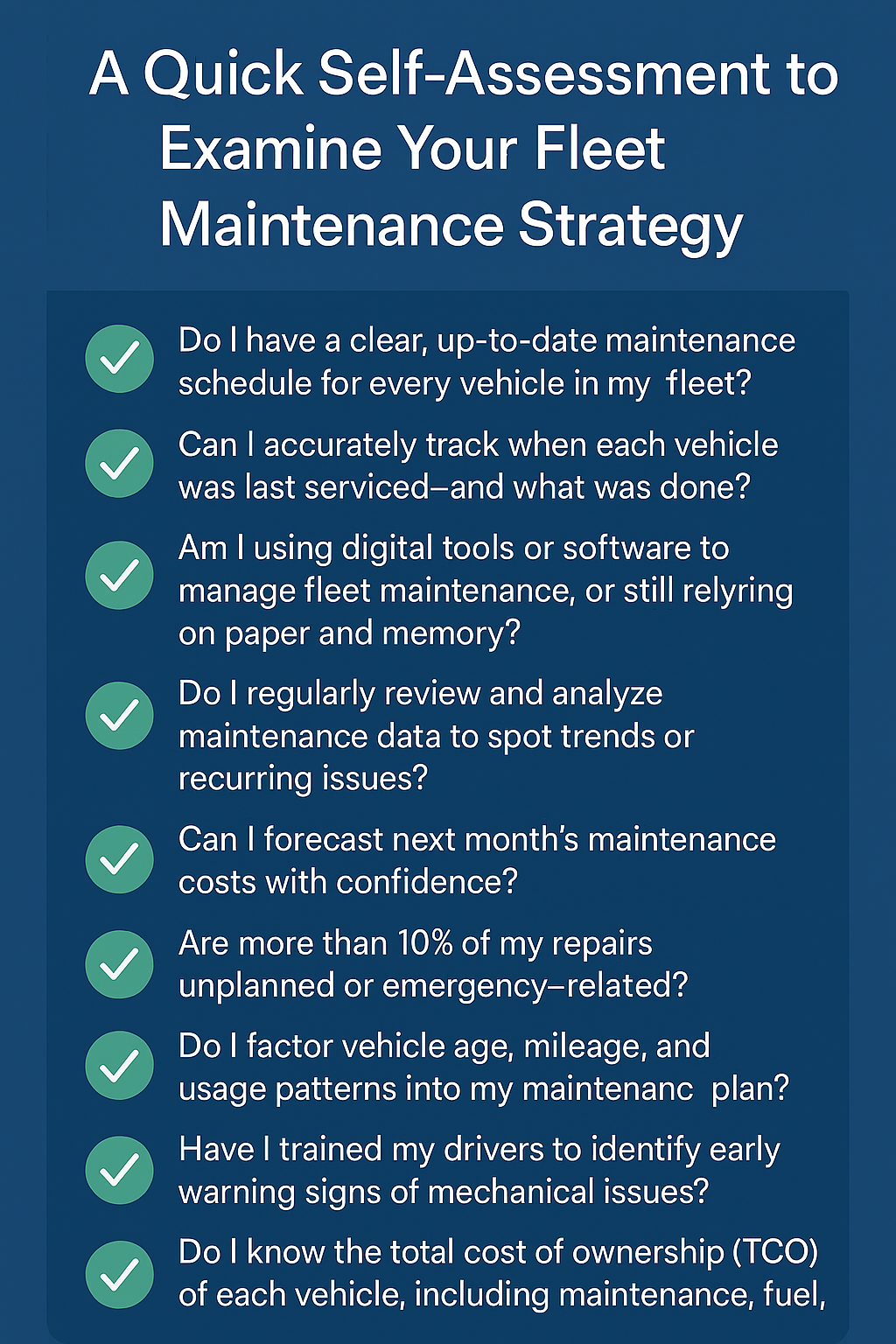
If you answered "no" to more than three questions or are unsure about a few, it might be time to rethink your current fleet maintenance strategy. Even minor adjustments, such as tracking repairs digitally or enhancing communication with drivers, can lead to significant cost savings and efficiency gains over time.
Key Takeaways
Keeping your fleet on the road and out of the repair shop is not just about maintenance; it’s about mindset. Emergency repairs may seem quick, but they often result in inflated costs, unexpected delays, and dissatisfied customers. On the other hand, preventive maintenance gives you something invaluable: control. When you take a proactive approach, you’re not just reacting to problems but stopping them before they start. You schedule inspections, fix minor issues before they become major repairs, and use smart data to guide every decision. That’s how you protect your bottom line and keep operations running smoothly. Think of preventive maintenance as an investment, not an expense. It's the key to longer vehicle lifespans, fewer customer complaints, lower liability, and more predictable costs. In today’s competitive environment, reliability is everything; your fleet reflects your business. So take the wheel. Shift from reactive to proactive. The best time to maintain your fleet isn’t when it breaks down, it’s before it ever does.

.avif)