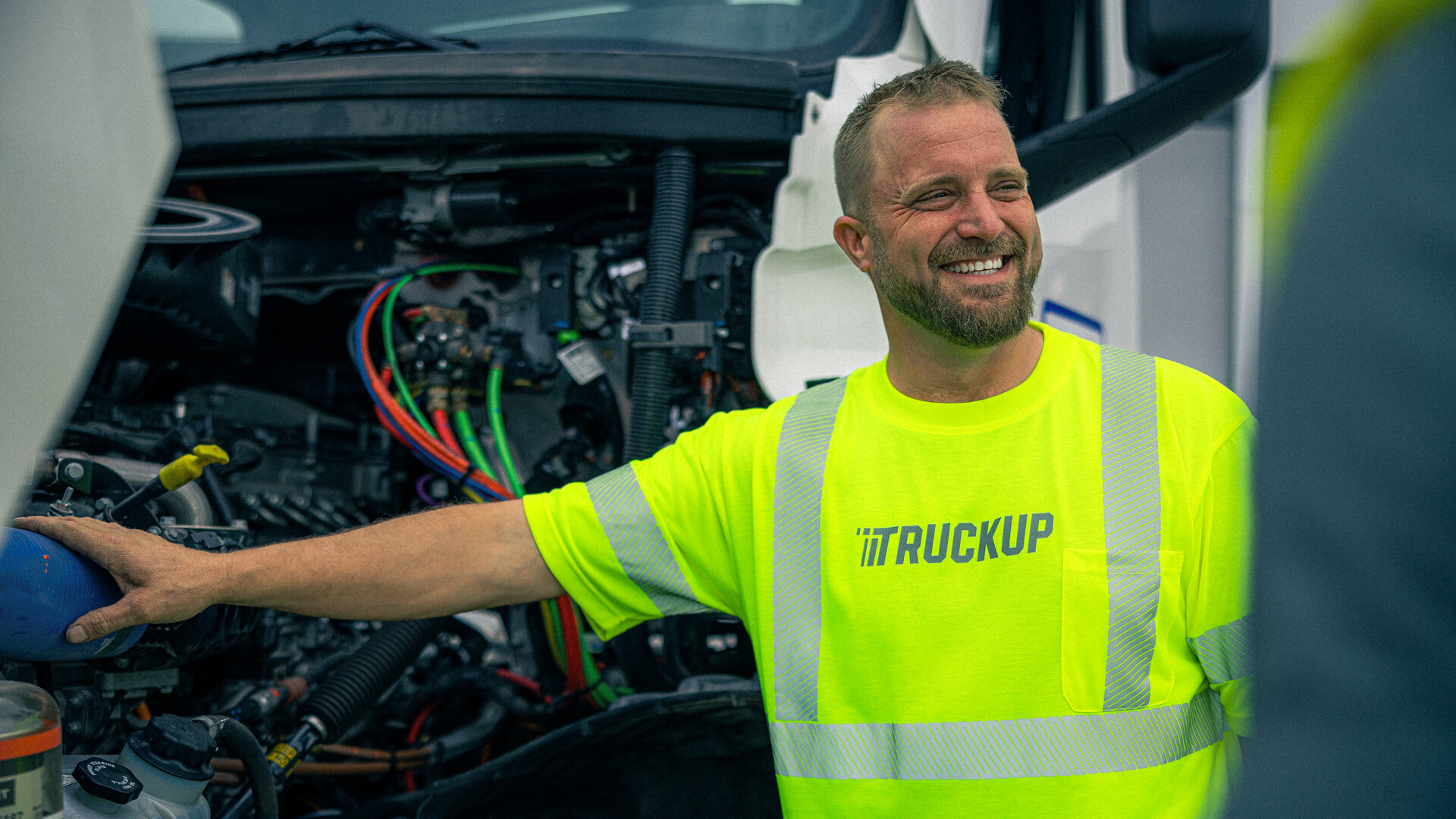
Charles "Chaz" Bryant, a fleet manager for Sunrise Moving & Packing, spent $40,000 across multiple repair shops trying to fix a single used truck for weeks, and it still wouldn’t run.
Then, he called Truckup. Tracy, a mobile mechanic, was dispatched to his location. It took three hours for him to clear the codes and fix what $40,000 and several vendors couldn’t.
“It took one guy who actually knew what the hell he was doing,” says Chaz.
Now, Chaz and Sunrise Moving plan to keep using Truckup as they expand to new locations and grow with them as a partner.
Chaz’s $40,000 loss isn’t unique. It's a predictable outcome of how the traditional shop repair model is structured.
Why couldn’t multiple shops fix what one tech solved in an afternoon?
Key Takeaways
- Flat-rate compensation drives diagnostic shortcuts. Mechanics paid by "book time" lose money on thorough diagnostics, incentivizing part replacement over root-cause analysis.
- 65.5% of diesel shops are understaffed, creating 2-4 week dwell times before a truck is touched.
- Vague invoicing prevents fleet tracking. The difference between a $1,895 cell receipt and itemized documentation determines whether maintenance data is usable for fleet analysis and warranty claims.
- The cost gap between traditional and on-site mobile repair models is significant. A $40,000 traditional breakdown episode vs. a $1,000 same-day mobile fix, a 90% cost difference in Sunrise's case.
The Parts Cannon: Why Shops Guess Instead of Diagnosing
Chaz’s situation is an example of parts cannon solutioning, where in-house shop mechanics throw parts and repairs at the wall and hope one of them will stick.
This isn’t because of laziness or lack of skill. It’s a structural flaw in how the traditional repair shop model works.
There are a few reasons why mechanics do this:
- Flat-rate compensation: Techs lose money by being thorough. Mechanics who are paid by “book time” rather than actual hours worked have no financial incentive to perform time-consuming diagnostics.
- Training gap: 61.8% of diesel technicians enter the field with no formal training (ATRI, 2025). Even among graduates of formal programs, over 30% were rated unqualified across 20 core skill areas, including the electrical diagnostics required for modern truck sensors.
- Parts markup: Shops typically target 40-60% margins on parts (AutoLeap), with industry consultants recommending 100% markup to achieve 50-55% profit margins (ALLDATA). Lower-cost components like sensors and filters carry the highest percentage markups.
Chaz has learned to recognize this pattern.
“If I'm calling you and you're giving me hella cart stuff, I just don't want to do business with you,” says Chaz. “That seems like a way you want to rack up my price."
That’s likely what happened with Sunrise’s truck. Moving it from shop to shop made it easier for the vendors to replace expensive components without oversight, billing $2,000-5,000 per repair.
Three Hidden Costs of Traditional Shop Repairs
Charles's $40,000 repair bill only tells part of the story. Traditional shop repairs impose a "triple hidden tax" on fleet operators.
- Logistics Tax: Heavy-duty towing runs $300-$600 for hookup plus $7-15 per mile. Plus, shops need to send two drivers, one to fix the problem and one to take the first driver back. Each of them adds an estimated $200-250 to your invoice in hidden labor.
- Time Tax: Average shop dwell time reached 2-4 weeks in 2024-2025 (ATRI) because of the technician labor shortage. That’s another $7,000-14,000 (at $500/day) before repairs even begin.
- Guesswork Tax: Flat-rate pay means techs lose money on thorough diagnostics, and shops earn 45-55% margins on parts (Institute for Automotive Business Excellence). The system rewards swapping a $5,000 component over spending 15 minutes finding the real issue.
These costs are easy to miss because they rarely appear as line items. They're scattered across vendors, buried in labor rates, disguised as legitimate parts charges, or absorbed as downtime that never hits an invoice.
Diagnosis vs. Guessing: Why the Approach Matters
What made Tracy’s approach stand out from the other shops Chaz went to first?
When Tracy answered Chaz’s first call, he:
- Arrived on-site with the right diagnostic equipment
- Read the actual fault codes, one by one
- Cleared codes properly, instead of replacing parts blindly
Without a proper diagnosis, repair shops default to expensive replacements. Modern diesel trucks have dozens of sensors that connect across emissions, fuel, and aftertreatment systems. A DPF pressure warning could come from either of the following:
- Clogged sensor tube ($0 to clean)
- Faulty sensor ($200)
- Bad DPF assembly ($5,000+)
Tracy resolved in three hours what multiple shops failed to fix over three months.
“That's how we do business at Sunrise,” says Chaz. “Anybody that doesn't BS me and is straight up honest with me is going to get priority on our business."
Documentation and Transparency Matter
Apart from the repair itself, Tracy’s detailed invoicing also made Chaz’s life much easier.
Vague invoicing is common in the shop repair industry. Without itemized documentation, fleet managers can’t track maintenance history, warranty claims, or build usable fleet data.
“You would not believe the number of people who send you a cell receipt. '$1,895 to XYZ Incorporated.' Doesn't even say what it's for,” says Chaz. “It almost feels like you're wasting money because there's no way to come back."
An itemized breakdown shows you exactly what you’re paying for, and why. The invoices Tracy sends him integrate seamlessly into Motive, his fleet management system, which makes his admin headaches much easier.
"That's another thing I love about Truckup, their detailed invoices,” says Chaz. “It breaks down everything the guy did and shows me my truck number. Dave sends it over immediately after work's done. I immediately downloaded that invoice into Motive. Done deal. Real quick, real easy, not a big headache on my end."
Shop vs. Mobile: Cost Comparison
Chaz’s experience is a classic example of the problems mobile repair helps solve:
What Sunrise was paying with traditional shops:
- $40,000+ in failed repair attempts
- Multiple towing events at $950+ each
- Weeks of downtime per breakdown
- Zero accountability for misdiagnosis
- Opaque invoicing that prevented fleet tracking
What the mobile model delivered:
- $395 callout + $140/hour transparent pricing
- Zero towing logistics or chase car expenses
- 3-hour fix for what shops couldn't solve in months
- Same-day service maintaining revenue streams
- Detailed documentation integrated into fleet systems
The staffing shortage across traditional shops isn't improving. 65.5% of repair shops are understaffed, and average dwell time ranges from 2 to 4 weeks. Fleet managers can’t afford to wait that long.
The Result
Chaz now comes to Truckup as his first solution whenever he has a problem.
Sunrise spent $40,000 across multiple shops without resolving the issue. A single mobile mechanic with proper diagnostic training resolved it in three hours.
"I wish there were just more Truckup mobile techs out there that I could call and have more work done,” says Chaz.
FAQ: What Fleet Managers Ask About Shop vs. Mobile Repair
1. Why do shops keep replacing parts without fixing the problem?
It's called the "Parts Cannon" approach—and it's not incompetence. Flat-rate pay means techs lose money on thorough diagnostics. Shops also make 45-55% margins on parts. The system rewards replacing a $5,000 component over spending 15 minutes finding the real issue.
2. How much does truck downtime actually cost?
Downtime costs you $500 per-day minimum in lost revenue. Add $950+ for towing, $200+ for chase car logistics, and $7,000-14,000 in dwell time if you're waiting 2-4 weeks before a shop starts working on your truck.
3. Why are shop wait times so long right now?
65.5% of diesel shops are understaffed. The technician shortage means 2-4 week dwell times are now normal. Your truck sits in a queue before anyone even looks at it.
4. What should a legitimate repair invoice include?
Itemized breakdown of every part, labor hours, truck number, and work performed. If you're getting "$1,895 to XYZ Inc" with no details, you can't track maintenance history, file warranty claims, or know what you actually paid for.
5. When does mobile repair make more sense than a shop?
When you can't afford 2-4 weeks of downtime, don't want to pay $950+ towing fees, or need someone who'll actually diagnose before replacing. Mobile techs eliminate the logistics tax entirely and typically resolve issues same-day.
6. How do I know if a shop is using the Parts Cannon on me?
Watch for: multiple expensive repairs that don't solve the original problem, vague invoices, pressure to replace major components without diagnostic explanation, and variable pricing with hidden surcharges. Transparent vendors give you flat rates upfront.


.avif)